
Tirana at the crossroads of the ancient Kandavia and Egnatia routes
Before the Via Egnatia existed, ancient roads passed from Durrës along the course of the Erzen and Shkumbin rivers. Strabo said that whoever controls the Kandavia road, the Illyrian segment of the Via Egnatia, also controls Monastery, Skopje. Where the Kandavia Road ended, Macedonia began. Early historical sources recount that Phoenician traders followed this road to reach the Adriatic during the Bronze Age (A. Stipevic, Illyrians, Life, Culture, p. 46). The Hellenes also followed the same Shkumbin valley route during their colonization, where after Durrës and Apollonia, they wanted to control these roads in the hinterland, in the 6th century BC. So the Kandavia road is older than the Via Egnatia. Therefore, this road played a role in the construction of urban centers or castles where the Kandavia Road passed. This road passed from Durrës then to Ndroq, along the Erzen Valley to Dorëz, Petrelë, the Krraba mountain range and further on to Shkumbi to Macedonia.
Even today there are sections of the Erzen that form these roads:
Durrës- Erzen Valley, Dorëz, Pezë e Vogël, Vrap, Peqin where it joined the route of the Kandavisa Road/Via Egnatia
Durrës, Ndroq, Arbanë, Baldushk, Krraba, then it came out into the Shkumbi Valley where it connected to the Via Egnatia for Macedonia. This explains why there are so many ancient fortresses and settlements along this entire axis. According to Kristo Frashëri, History of Tirana, p. 19, the fact of the existence of this road is the great discoveries on this axis, which show that this area was not disconnected from the ancient Mediterranean culture. Two are the largest discoveries: The figurine of Hermes in a monumental tomb in Bërzhitë, 5.5 cm high, a symbol of the protection of trade and travel, and a bronze coin of the Epirote League from the 3rd century BC. Here Frashëri says that these findings show that a variant of the Via Egnatnia passed here, which started from Durrës, passed through the Ndroq Corridor, then through the Erzen Valley, near Baldushk and Qafë e Krraba and ended at Shkumbi where it connected to the larger Via Egnatia. The evidence that the road passed here is confirmed by the figurine of Hermes, as similar ones have been discovered along the entire Via Egnatia.
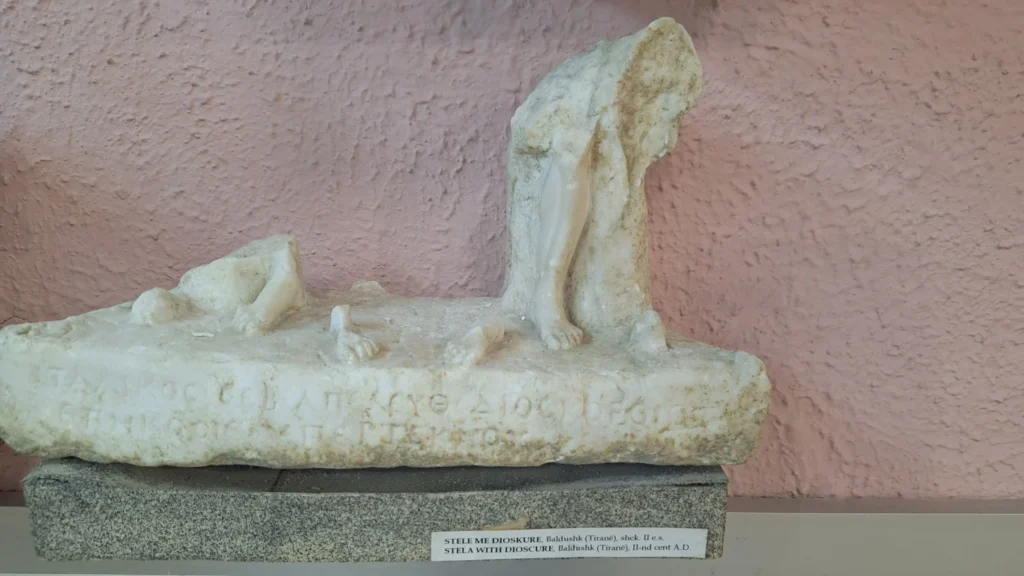
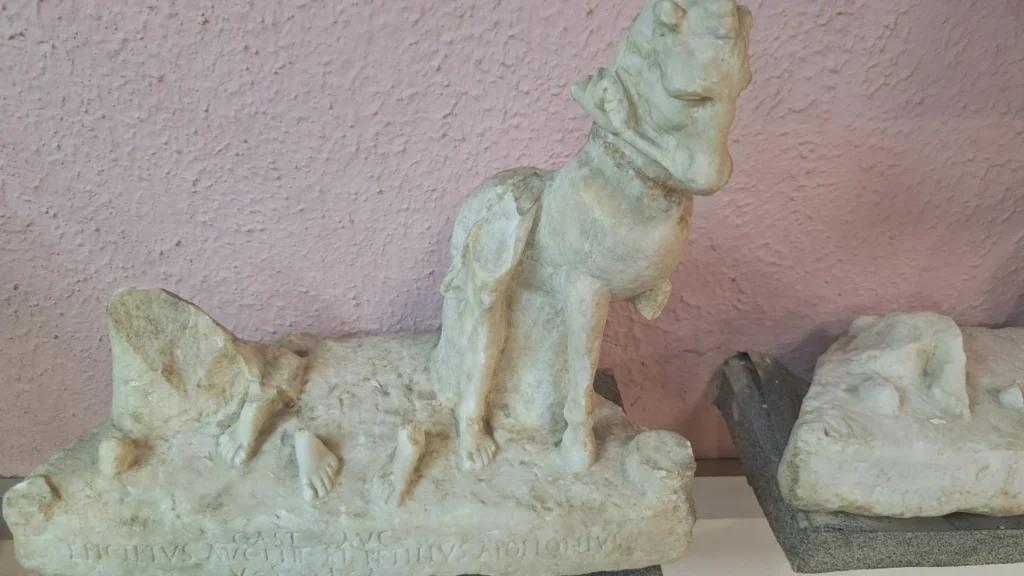
Another discovery in the secondary variant of the Via Egnatia was found in the Baldushk area, south of the capital. The dwelling of the village of Koçaj dates back to the 1st century AD. Two plinths of ancient sculptures were discovered here, which in such a mountainous environment are simply extraordinary. Both unique sculptures have a base where horses and a boy holding their reins are carved. Interestingly, both sculptures also had an inscription in two languages, Latin and Greek, dedicated to the Dioscuri (Castors) and are thought to have been written by imperial slaves. So the fact that the same master writes in two languages, Latin and Greek, shows that here too these languages were used equally for cultural purposes. The history here is such that state slaves were freed in Dyrrachium and came to these lands to spend the rest of their lives as farmers. Such stories can be told to tourists who are interested in ancient finds in these territories, which were actually numerous, such as the tombstone in Valias, the tombstone in Kashar with an inscription in Latin, the tombstone in Paskuqan also in Latin, the tombstone in the village of Lalm, a Latin inscription from a freed slave. Gravestone in the village of Allgjatë, also in Latin, epitaph of a 1st century AD slave. The latter, who died young, had left a request that the tombstone be paid for from her savings. Most of these grave stelae are in the Archaeological Museum of Tirana.
This article is part of the Tirana Heritage Routes, a project by DMO ALBANIA, in the framework of the BOOST Balkans program, implemented by ALDA and consortia, funded by AFD France


Disclaimer: The views, opinions and content expressed in this publication are those of the author(s) and do not necessarily reflect the official position of the European Association for Local Democracy-ALDA and Agence Française de Développement (AFD). ALDA and AFD are not responsible for any use that may be made of the information contained therein
Tags:

Other News to Read
Tirana Heritage Routes: 5+1 New Ways to Discover Tirana Beyond the City Centre
he Tirana Heritage Routes project presented five new thematic routes combining history, culture, heritage, nature, and local communities…
What to do in October 2026 in Tirana
Tirana, Hello Autumn! Welcome October! October in Tirana is a vibrant, colorful month — a lovely fusion of…
What to Do in Tirana in September 2026
What to do in September 2026 in Tirana . The month of Festivals and cultural activities
Tirana Castle: A Fortress with Ancient Roots
Tirana Castle: A Fortress with Ancient Roots. t is traditionally said to have been built in the 18th…