
Bastar: A journey through time and legend

  • Bastari, located near the Tujan area approximately 18 km from Tirana, offers a remarkable combination of ancient history, archaeology, mountain landscapes, traditional village life, and one of the most intriguing archaeological mysteries in the region.

    The story begins in 1955, when two ancient helmets—one Illyrian and one Corinthian—were discovered during agricultural work in an area known as Qytezë, on a hill in Bastari i Mesëm. The two helmets were found close together in what appears to have been a burial context. Today, they are displayed side by side in the Archaeological Museum of Tirana.

    According to archaeologist Adem Bunguri, both helmets date to the 6th century BC and were objects of considerable value, probably belonging to princes, military commanders, or members of the highest social elite. Their craftsmanship and cost suggest that they could not have belonged to ordinary warriors.

    Yet the discovery raises a fascinating question that remains unresolved: why were an Illyrian helmet and a Corinthian helmet buried beside one another?

    The mystery becomes even more intriguing because the helmets were discovered in territory associated with the ancient Parthini. Historian and archaeologist Hasan Ceka noted that in the 4th century BC the name Bastar was associated with a king of the Paeonians, an ancient people of the northern Balkans. According to this interpretation, the name raises another question: how could the name Bastar have become associated with a territory traditionally connected with the Parthini?

    Another intriguing possibility is that the Paeonian king Bastar may have possessed both helmets because of their exceptional value, and that he could have died in this territory and been buried with them. Under this hypothesis, the settlement itself may have preserved his name.

    Two helmets, two traditions, one name—Bastar.

    The archaeological mystery of Bastar therefore becomes the central theme of the tour, connecting ancient military culture, burial customs, regional identities, and the unexplained relationship between two exceptional helmets.

    Beyond its archaeological heritage, Zall-Bastar offers spectacular mountain scenery. The administrative unit lies within a rugged mountainous landscape and consists of 12 villages. Its territory covers approximately 132 km², including agricultural land, forests, and pastures. Valleys, steep slopes, wooded hills, traditional settlements, and panoramic viewpoints create an authentic rural landscape only a short distance from Tirana.

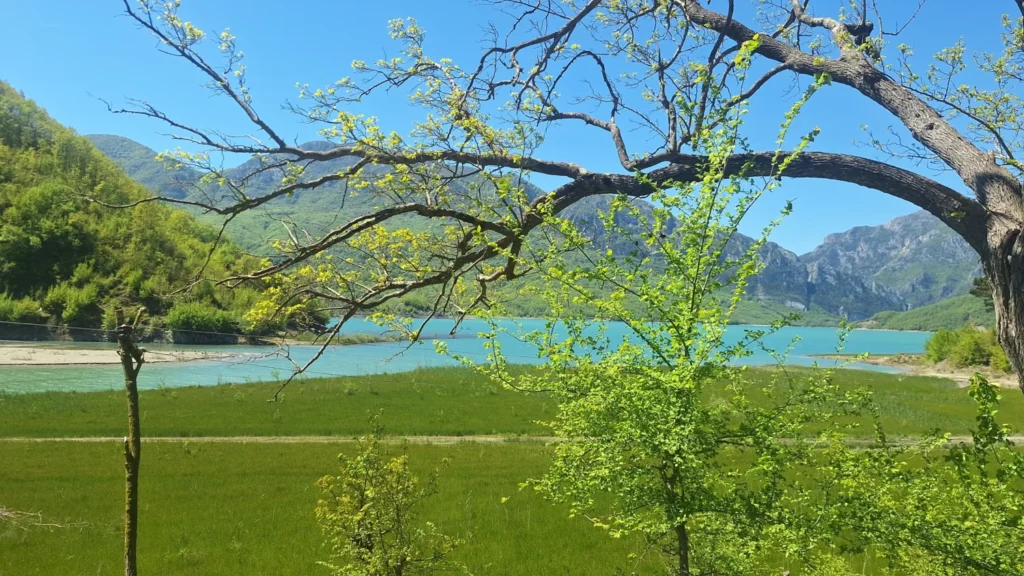
    The journey continues toward Lake Bovilla, one of the most spectacular natural destinations near the capital. Here, mountains, water, forests, and dramatic landscapes combine to create one of the most impressive panoramic environments in the Tirana region.

    The route can then continue toward the mountain village of Vilëz, near the boundary between Tirana and Dibër. From the surrounding heights, visitors can admire several mountain ranges at the same time, including Dajti, Bovilla, Tujan, and the mountains of Krujë associated with Skanderbeg. On exceptionally clear days, the views may extend toward Tirana and even Durrës.

    The experience is completed by the traditional hospitality of the mountain communities. Local cuisine, family traditions, shepherding, village life, and the knowledge preserved by older generations provide visitors with an opportunity to experience a side of Tirana that remains deeply connected to its rural heritage.

    This tour therefore combines archaeology, mystery, nature, traditional culture, gastronomy, and panoramic mountain landscapes in one journey from the ancient world to contemporary rural Albania.

    1 Day Tour

    09:00 – 10:30

    Bastar and the Archaeological Mystery of the Two Helmets

    The tour begins in Bastar, approximately 18 km from Tirana, in the mountainous territory of Zall-Bastar.
    The village preserves one of the most unusual archaeological discoveries in the region. In 1955, during agricultural work, two ancient helmets were discovered in an area known as Qytezë, on a hill in Bastari i Mesëm.
    The discovery consisted of:

    • One Illyrian helmet
    • One Corinthian helmet
    • Both dating to approximately the 6th century BC
    • Both discovered close together in a burial context
    • Both now preserved side by side in the Archaeological Museum of Tirana

    According to archaeologist Adem Bunguri, the quality, rarity, and cost of the helmets suggest that they belonged to members of the highest social and military elite, possibly princes or senior commanders.
    The discovery immediately raises an extraordinary historical question:
    Why were two different types of helmets buried together?
    The Illyrian helmet is relatively well preserved and has a more regular appearance. The Corinthian helmet, however, bears a distinctive impact mark close to the eye, a trace that remains visible today.

    Was the damage caused during combat?
    Did both helmets belong to the same ruler?
    Were two military leaders killed in the same conflict?
    Could two opposing warriors have been buried together?
    No definitive answer has yet been established.

    10:30 – 11:30

    The Bastar Name and the Paeonian Connection

    The archaeological mystery is further complicated by the name Bastar.
    The discovery site lies within a territory associated with the ancient Parthini, an Illyrian tribe known from classical sources.
    Hasan Ceka proposed an intriguing connection between the name Bastar and a Paeonian king named Bastar, associated with the 4th century BC.
    The Paeonians were an ancient people who inhabited territories in the northern Balkans, particularly around present-day North Macedonia.

    This raises another fascinating question:
    How did the name Bastar become associated with this territory?
    The mystery becomes even more interesting because the Paeonian king Bastar is associated with coinage depicting an Illyrian-type helmet.

    Several interpretations can therefore be considered:
    • The name Bastar may have an ancient linguistic or geographical origin.
    • The settlement may preserve the name of a historical ruler.
    • The helmets may have belonged to an individual of exceptionally high status.
    • The two helmets may represent two different warriors connected to a conflict.
    • The burial may preserve evidence of an interaction between different cultural and military traditions.

    One particularly intriguing hypothesis suggests that King Bastar may have possessed both helmets because of their exceptional value, died in this region, and was buried together with them.
    According to this interpretation, the settlement may subsequently have preserved his name.
    The theory remains unproven, but it adds another layer to the archaeological mystery of Bastar.

    Two helmets, two traditions, one name—Bastar.

    11:30 – 13:00

    Lake Bovilla

    The journey continues toward Lake Bovilla, one of the most spectacular natural landscapes near Tirana.
    Visitors can reach the area from Bastar on foot or, depending on road conditions and the selected route, by four-wheel-drive vehicle.

    The landscape combines:
    • Dramatic mountain slopes
    • Green valleys and meadows
    • Forests and pastures
    • Clear mountain air
    • Panoramic views over Lake Bovilla
    • Traditional rural settlements

    Bovilla offers an opportunity to step away from the urban environment of Tirana and experience the natural landscape of the surrounding mountains.
    Visitors can enjoy a picnic in the green meadows around the lake or simply take time to appreciate the scenery and tranquility.
    The area has retained much of its natural and authentic character, making it particularly attractive for visitors interested in nature, photography, hiking, and rural tourism.

    13:00 – 14:30

    Vilëz and the Mountain Panorama

    The tour continues toward the mountain village of Vilëz, situated near the boundary between Tirana and Dibër.
    The village offers one of the most impressive panoramic viewpoints in the region.

    From the surrounding mountains, visitors can admire several major mountain landscapes simultaneously:
    • Dajti
    • Bovilla
    • Tujan
    • The mountains of Krujë and the region associated with Skanderbeg

    On exceptionally clear days, the panorama can extend toward Tirana and Durrës.
    Although the mountain roads can be difficult, the effort is rewarded by extraordinary views over the surrounding valleys and mountain ranges.
    The area also offers an opportunity to experience traditional village life and the close-knit character of the local community.

    14:30 – 15:30

    Traditional Mountain Life and Local Cuisine

    The final part of the tour introduces visitors to the traditions and hospitality of the mountain villages around Bastar and Vilëz.
    Local communities have preserved many elements of traditional rural life, including:
    • Shepherding and livestock farming
    • Traditional food preparation
    • Family customs
    • Knowledge transmitted between generations
    • Respect for older members of the community
    • Traditional hospitality
    A visit to a local restaurant offers the opportunity to experience regional cuisine prepared according to recipes passed down through generations.

    Traditional dishes may include:
    • Byrek me qumësht
    • Pulë me thërrime
    • Other seasonal and locally prepared dishes

    The meal provides an authentic conclusion to a journey that combines archaeology and nature with the living cultural heritage of the Tirana mountains.

    15:30

    End of Tour

    The tour concludes after exploring Bastar, Bovilla, and the surrounding mountain villages.
    Visitors leave with a story that combines an unresolved archaeological mystery, ancient peoples and rulers, spectacular landscapes, traditional food, and the hospitality of rural communities.
    The two ancient helmets remain at the heart of the story.

    Their discovery in Bastar raises questions that archaeology has not yet definitively answered: Who wore them? Why were they buried together? Were their owners allies or enemies? And what connection, if any, exists between the helmets, the name Bastar, and the ancient peoples who inhabited this region?

    The answers remain uncertain—and this is precisely what makes Bastar such a fascinating destination.

    Multiple Days Tour

    Itinerary Map

    Photo Gallery

    Tour Details

    • Duration: Full Day – Approximately 6.5 hours
    • Difficulty Level: Moderate
    • Experience Type: Archaeology, history, nature, hiking, local culture, gastronomy, and rural tourism
    • Group Size: Suitable for individuals, families, small groups, private tours, and educational groups
    • Languages: Albanian / English
    • Location: Zall-Bastar, Bastar, Bovilla and surrounding mountain villages

    What's Included

    ✔ Professional licensed tourist guide
    ✔ Guided visit to the Bastar archaeological area
    ✔ Historical interpretation of the two ancient helmets
    ✔ Guided exploration of the Bastar and Bovilla landscapes
    ✔ Visit to the mountain villages and panoramic viewpoints
    ✔ Introduction to local history, traditions, and rural culture

    What's Not Included

    ✘ Meals and drinks
    ✘ Personal expenses
    ✘ Transportation unless requested as part of the package
    ✘ 4×4 transportation where required by road conditions
    ✘ Optional activities not specified in the itinerary

    Suggested Price

    €…… / person

    Recap

    The tour is particularly recommended during April and May, when the mountain valleys are at their most vibrant and the Poet’s Narcissus (Narcissus poeticus) blooms at certain elevations, creating spectacular natural landscapes.
    Spring is also an excellent period for hiking, photography, and enjoying the mountain scenery before the hotter summer months.

    Discover a different side of Tirana, where ancient archaeology meets spectacular mountain landscapes and traditional Albanian village life.
    Experience traditional food, local hospitality, shepherds, mountain valleys, forests, and communities where ancient customs continue to influence everyday life.

    Bastar is more than a village. It is an archaeological mystery, a mountain destination, and a living fragment of the ancient landscape surrounding Tirana.

    Subscribe to our Newsletter!