

Bastari, located near the Tujan area approximately 18 km from Tirana, offers a remarkable combination of ancient history, archaeology, mountain landscapes, traditional village life, and one of the most intriguing archaeological mysteries in the region.
The story begins in 1955, when two ancient helmets—one Illyrian and one Corinthian—were discovered during agricultural work in an area known as Qytezë, on a hill in Bastari i Mesëm. The two helmets were found close together in what appears to have been a burial context. Today, they are displayed side by side in the Archaeological Museum of Tirana.
According to archaeologist Adem Bunguri, both helmets date to the 6th century BC and were objects of considerable value, probably belonging to princes, military commanders, or members of the highest social elite. Their craftsmanship and cost suggest that they could not have belonged to ordinary warriors.
Yet the discovery raises a fascinating question that remains unresolved: why were an Illyrian helmet and a Corinthian helmet buried beside one another?
The mystery becomes even more intriguing because the helmets were discovered in territory associated with the ancient Parthini. Historian and archaeologist Hasan Ceka noted that in the 4th century BC the name Bastar was associated with a king of the Paeonians, an ancient people of the northern Balkans. According to this interpretation, the name raises another question: how could the name Bastar have become associated with a territory traditionally connected with the Parthini?
Another intriguing possibility is that the Paeonian king Bastar may have possessed both helmets because of their exceptional value, and that he could have died in this territory and been buried with them. Under this hypothesis, the settlement itself may have preserved his name.
Two helmets, two traditions, one name—Bastar.
The archaeological mystery of Bastar therefore becomes the central theme of the tour, connecting ancient military culture, burial customs, regional identities, and the unexplained relationship between two exceptional helmets.
Beyond its archaeological heritage, Zall-Bastar offers spectacular mountain scenery. The administrative unit lies within a rugged mountainous landscape and consists of 12 villages. Its territory covers approximately 132 km², including agricultural land, forests, and pastures. Valleys, steep slopes, wooded hills, traditional settlements, and panoramic viewpoints create an authentic rural landscape only a short distance from Tirana.
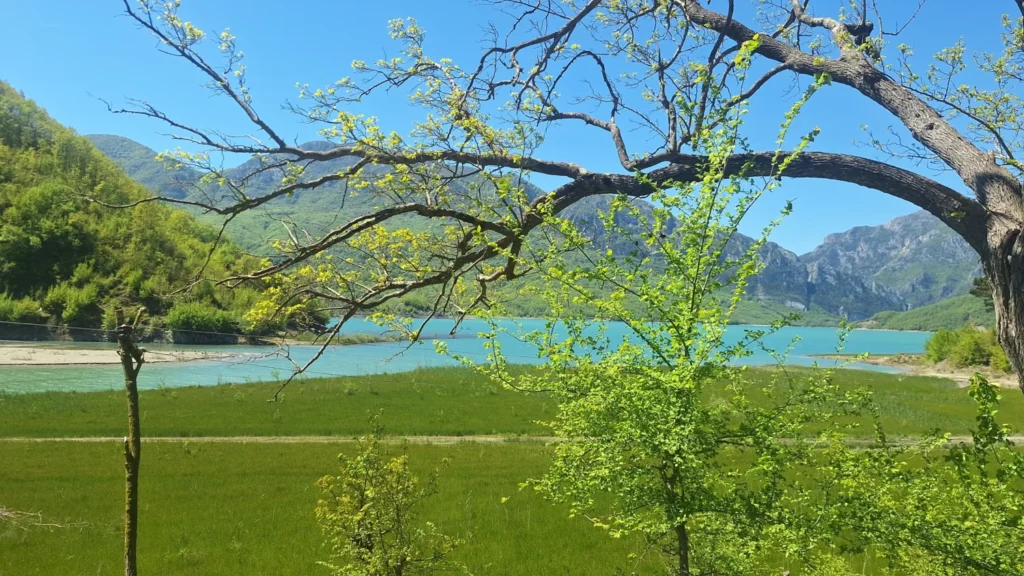
The journey continues toward Lake Bovilla, one of the most spectacular natural destinations near the capital. Here, mountains, water, forests, and dramatic landscapes combine to create one of the most impressive panoramic environments in the Tirana region.
The route can then continue toward the mountain village of Vilëz, near the boundary between Tirana and Dibër. From the surrounding heights, visitors can admire several mountain ranges at the same time, including Dajti, Bovilla, Tujan, and the mountains of Krujë associated with Skanderbeg. On exceptionally clear days, the views may extend toward Tirana and even Durrës.
The experience is completed by the traditional hospitality of the mountain communities. Local cuisine, family traditions, shepherding, village life, and the knowledge preserved by older generations provide visitors with an opportunity to experience a side of Tirana that remains deeply connected to its rural heritage.
This tour therefore combines archaeology, mystery, nature, traditional culture, gastronomy, and panoramic mountain landscapes in one journey from the ancient world to contemporary rural Albania.