
The Vrap Treasure: An Early Medieval Story from Tirana
South of Tirana, on the hills that separate the valleys of Zhullima, Peza, the Erzen River branches, and the Shkumbin basin, lies the village of Vrap. At first glance, it appears to be a quiet rural settlement. Yet at the dawn of the 20th century, Vrap entered European archaeological history with the discovery of an extraordinary treasure — the largest Early Medieval hoard ever found in Southeastern Europe.
This discovery places the territory of today’s Tirana at the center of one of the most important archaeological narratives of the Early Byzantine period.
A Discovery That Reached Europe
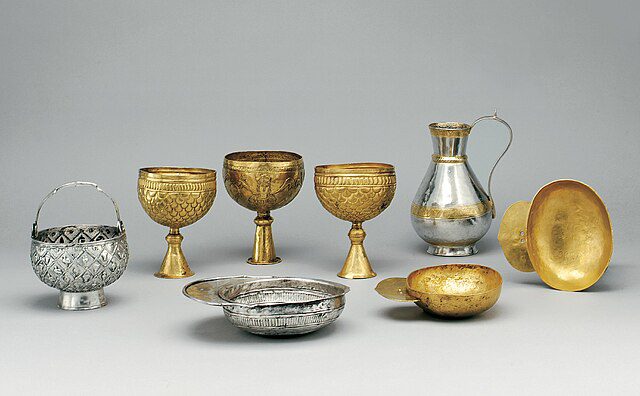
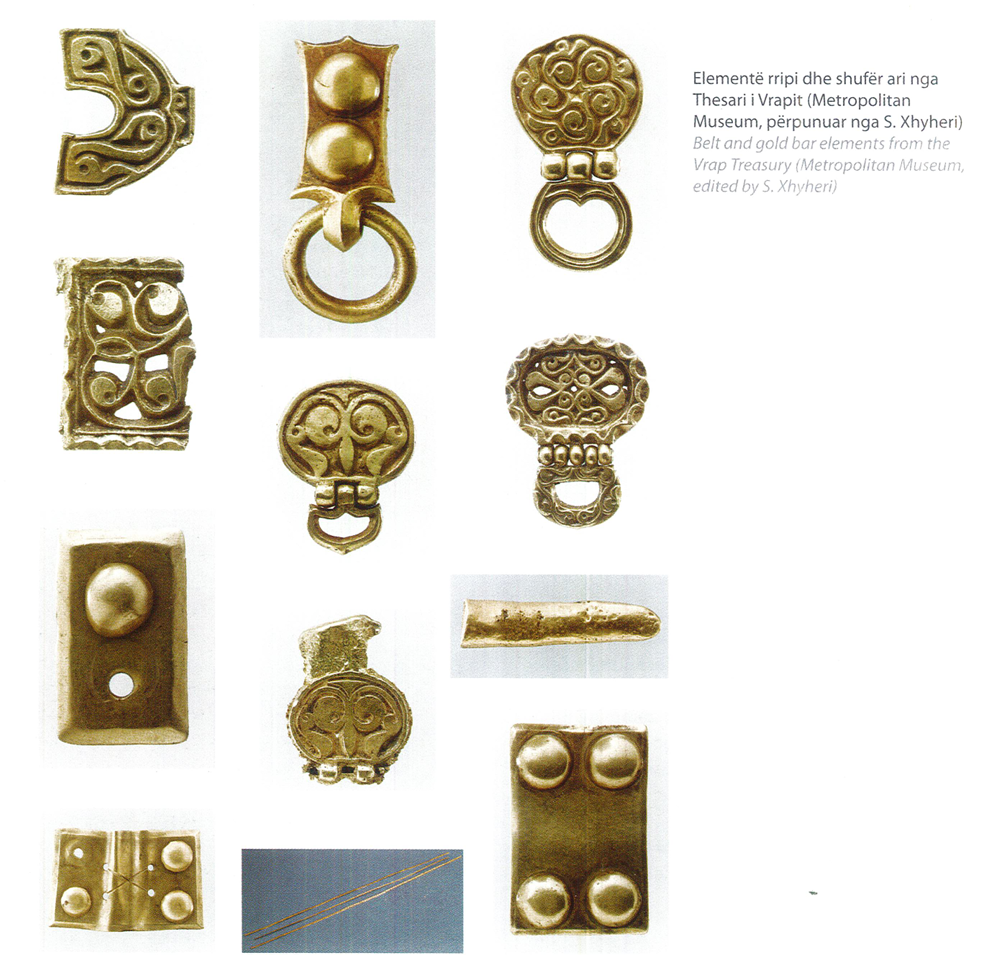
The treasure was discovered in 1901 by four villagers — Murat and Ali Biceri, and Met and Mustafa Mema — while working agricultural land near the village. Hidden inside a copper cauldron were gold and silver objects of exceptional craftsmanship, including liturgical vessels, bowls, belt fittings, and ceremonial items. The find was immediately recognized as extraordinary, even by local standards.
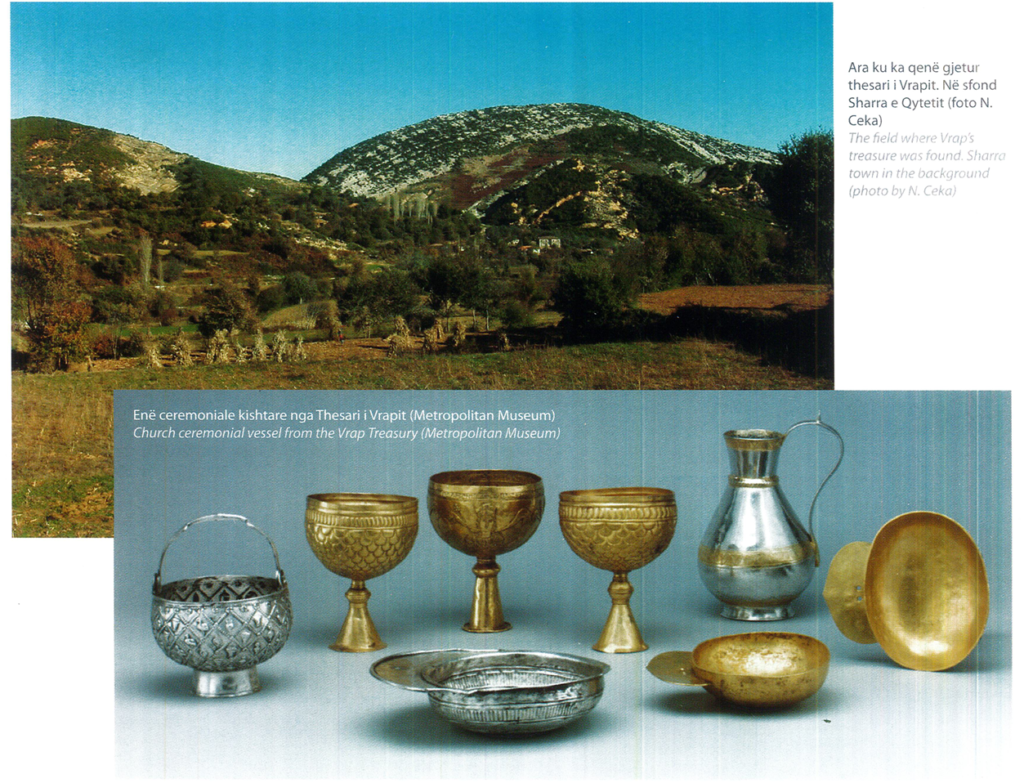
News of the discovery spread quickly. Ottoman authorities confiscated one of the gold cups and sent it to Constantinople, while other objects circulated quietly for several years before reaching European collectors. Between 1902 and 1907, 39 of the 41 objects were acquired by J. Pierpont Morgan through diplomatic mediation and have been preserved since 1917 in the Metropolitan Museum of Art in New York. Two objects ended up separately in Constantinople and Paris.
A Treasure Rooted in the Land of Tirana
What makes the Vrap Treasure exceptional is not only its richness — over 5.6 kg of gold and nearly 1.5 kg of silver — but its cultural meaning.
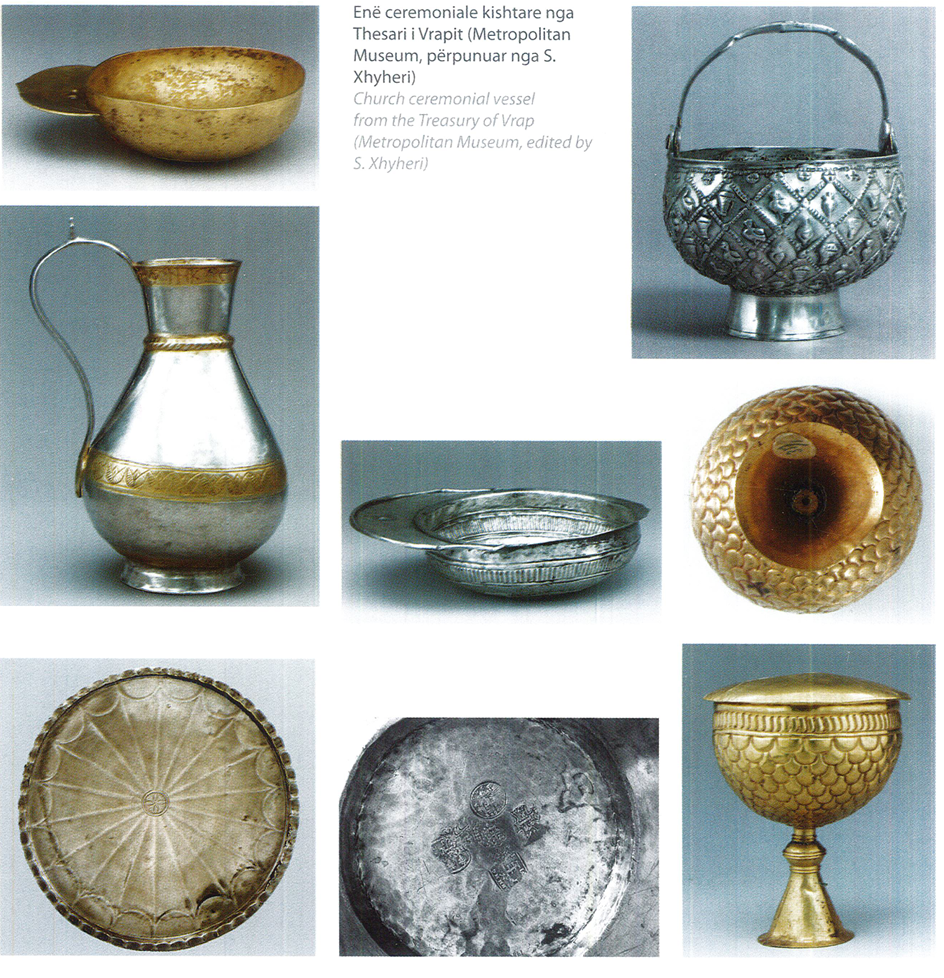
Several objects are unmistakably Christian liturgical vessels:
-
gold communion cups,
-
a silver holy-water container used in Byzantine churches,
-
inscriptions invoking God and biblical psalms.
Such objects could not belong to a transient or nomadic group. They presuppose stable Christian communities, churches, clergy, and continuity of worship.
In the 6th–7th centuries, the region of Tirana formed part of the western Balkan provinces of the Byzantine Empire — a landscape inhabited by Romanized descendants of the ancient Illyrian population, integrated into imperial administration, military service, and Christian institutions. From this same Illyrian heartland came more than twenty Roman and Byzantine emperors, generals, and officials who shaped the empire during Late Antiquity.
The Vrap Treasure fits precisely within this historical reality: local elite communities, Christian, connected to imperial networks, yet deeply rooted in the land they inhabited.
Style Is Not Identity
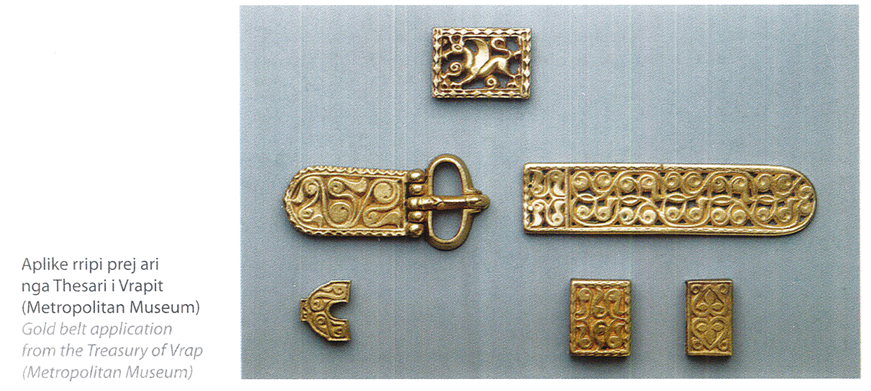
Some objects in the treasure display decorative forms shared across the Balkans and Central Europe during a time of intense political and cultural interaction. These stylistic elements — especially in belt fittings — reflect elite fashion and prestige symbols of the era, widely adopted by Byzantine provincial elites.
They do not indicate foreign settlement or ownership. In the Early Middle Ages, material style was fluid; identity was not defined by ornament. What defines the Vrap Treasure is not decoration, but function, context, and location — all of which point clearly to local ownership.
Why Was the Treasure Buried?
The most plausible explanation is emergency concealment during a period of instability marked by invasions, warfare, and population movements across the Balkans. Such acts of concealment are well documented throughout the Byzantine world. The treasure was never recovered by its owners — a silent testimony to a dramatic historical moment.
A Missing Chapter in Tirana’s History
The Vrap Treasure is not a peripheral or foreign episode. It is a central chapter of Tirana’s early history, revealing that this territory was not marginal, but fully embedded in the religious, cultural, and political life of the Early Byzantine Balkans.
It stands as material proof that Illyro-Roman descendants living in the area of present-day Tirana were active participants in the transformation of the Roman world, preserving faith, wealth, and identity during one of Europe’s most turbulent centuries.
Why This Story Matters Today
The Vrap Treasure reminds us that Tirana’s history does not begin in the Ottoman period or with modern statehood. Its roots extend deep into Late Antiquity, into a world where local communities shaped empire, not merely endured it.
This is Tirana’s story — long overlooked, but impossible to ignore.
Bibliography
-
J. Werner, New Aspects Related to the Avar Treasure of Vrap, Iliria, 1983, 1, pp. 181–201.
-
J. Werner, Der Schatzfund von Vrap in Albanien, Vienna, 1989.
-
Tirana Archaeology 100, N Ceka, S. Mucaj, L Perzhita

Other News to Read
What to do in March 2026 in Tirana
Welcome Spring, the best season to Visit Tirana. March is the first month of spring, and the flowers…
Ndroq Castle – The rock that saved a Byzantine Emperor
Ndroq Castle – The rock that saved a Byzantine Emperor – 1081. The story by Ana Khomena
The Ancient Origins of the Name Tirana- A toponymic and archaeological story
The Ancient Origins of the Name Tirana- A toponymic and archaeological story
Persqop-the Ilyrian city 4th century BC
The ancient castle of Persqop also known as “The Ancient town of Brysaka” is located to the south…