
The Ancient Origins of the Name Tirana- A toponymic and archaeological story
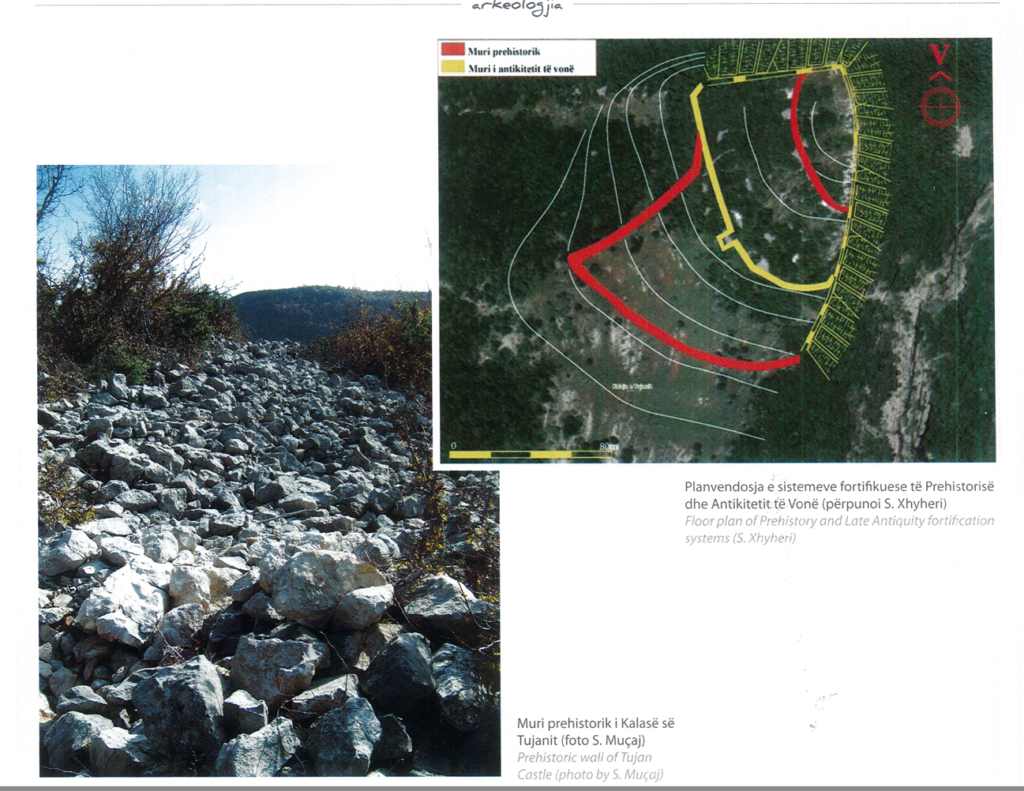
The origin of the name Tirana is deeply rooted in the ancient landscape of central Albania. Archaeological discoveries in the Tirana basin reveal continuous human occupation from prehistoric times, long before Roman, Slavic, or Ottoman periods. One of the most significant sites is Tujan Castle, located east of modern Tirana, where archaeologists have documented prehistoric fortification walls and later defensive structures from Late Antiquity (Xhyheri, Muçaj).
Here is what archaeologists Neritan Ceka, Skender Mucaj, and Luan Perzhita wrote in the book Tirana 2020- Archaeologia, pg 25-29
“The most important prehistoric fortification in central Albania is the Castle of Tuian, just a few kilometers east of Tirana. This castle is located on a conical hill, which separates the village of Tujan from the village of Shtish-Tufina. Its rocky outcrops limit a slope that descends gently from the top to the west. The east side, which is also the highest one, consists of a rocky outcrop, creating a natural protection that gradually descends to the west. Even on the north side, the rocky strip has a drop of about 3m, which makes it difficult to climb the castle. The highest part of the hill, with a height of 455m, is protected by a low wall arch with small, unworked stones, which closes between two falls. About 50m to its west follows another perimeter wall, which belongs to Late Antiquity, but which seems to have covered an earlier, wider arch of the prehistoric fortification. About 120m from the first arch follow the traces of the outer arch of the prehistoric fortification, built of large unworked stones and with unfilled gaps. Its width is 3m with a difference of facades from the filling. On the southwest side of the fortification, there is in this arch a space of about 5m, which served as an entrance. It was flanked by a fourth arch that created a corridor with an initial width of 10m and a length of 50m, which closed immediately after the entrance, through the meeting of the two arches. Just like in the prehistoric fortifications in Lleshan of Shpati and Karos of Himara, this arch crossed the edge of the cliff. Prehistoric pottery is found on the surface included inside the fortification. As such, the prehistoric fortification of Tujan represents one of the most interesting monuments of early Illyrian architecture.
During the Late Antiquity, the hill was used for the establishment of a fortification, which was part of the defence system of Dyrrhachium, as the capital of the Byzantine province of New Epirus.”
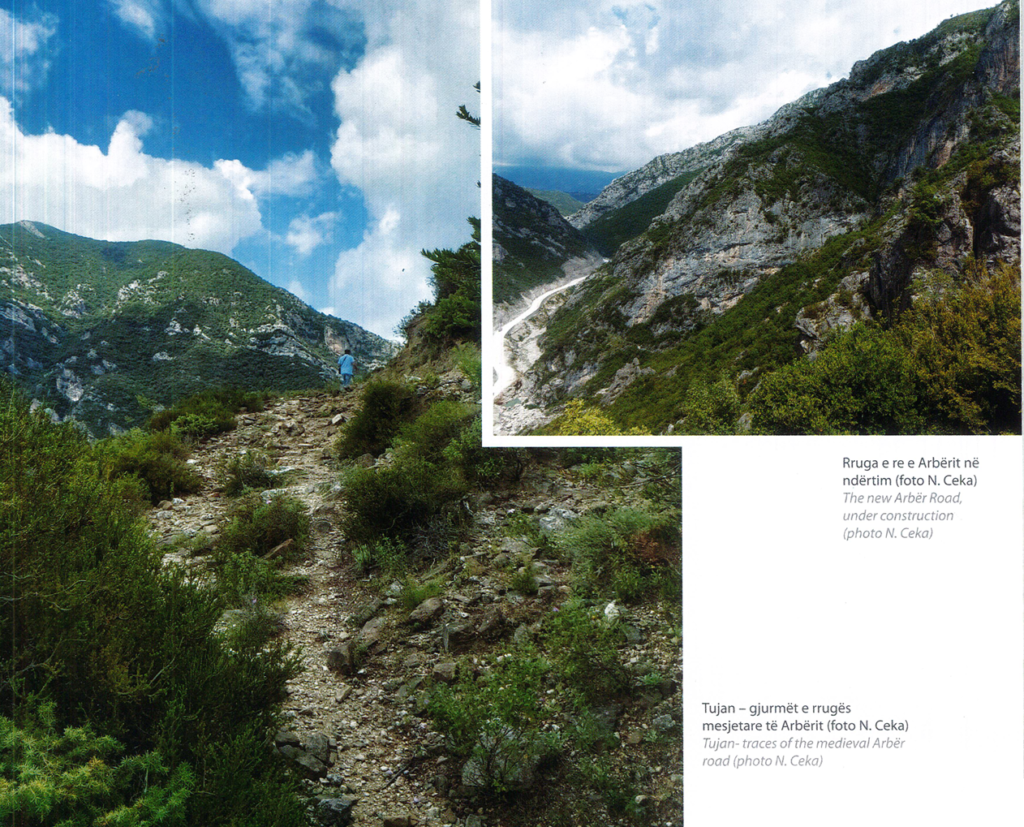
The presence of a prehistoric fortified settlement at Tujan demonstrates that this area was a strategic center in the Tirana valley thousands of years ago. Such fortified hilltop sites are typical of Illyrian and pre-Illyrian communities, indicating long-term indigenous settlement.
Toponymic Continuity in the Tirana Basin
The Tirana region preserves a dense network of related place names that reflect this ancient continuity. These include:
• Tirana River, the primary hydronym of the basin
• Tirkan / Tirkanë, a medieval settlement attested in historical sources
• Tujan, one of the oldest villages in the valley
• The city name Tirana, which later expanded as an urban center
In historical linguistics, rivers and valleys are known to preserve the oldest names, often surviving population and language changes. The cluster of Tir-/Tur-/Ter- place names in the Tirana basin strongly suggests a local ancient root, predating Slavic and Ottoman presence.
The Tir-/Tur- Root in the Ancient Mediterranean
The root Tir- / Tur- is widely attested in ancient Balkan and Mediterranean toponymy. Comparable names include Tyras (ancient Dniester River), Tiryns in Greece, Theranda in Kosovo, and the Tyrrhenians (Etruscans) in Italy. This root is considered part of the ancient pre-Indo-European and early Indo-European substrate of the Balkans and Mediterranean.
Some scholars, such as Massimo Pittau, have suggested a broader Mediterranean connection, linking Tirana with the Etruscan goddess Turan, highlighting possible linguistic parallels between Adriatic and Italian pre-Roman cultures. While such connections remain speculative, they point to the deep antiquity of the Tirana toponym.

From Prehistoric Valley to Modern Capital
The archaeological continuity at Tujan, combined with the persistent Tir-/Tur- toponymic system, indicates that Tirana is not a modern or foreign name but an indigenous ancient designation of the valley and its river. The city of Tirana likely inherited its name from this prehistoric landscape, reflecting millennia of continuous human presence.
Conclusion
The presence of prehistoric and Late Antique fortifications at Tujan confirms that the Tirana basin was an indigenous settlement area long before Slavic migrations and Ottoman rule, challenging older hypotheses that linked the city’s name to later foreign influences
Tujan Castle – Prehistoric Roots of Tirana
The fortified hill of Tujan preserves prehistoric and Late Antique walls, showing that the Tirana valley was inhabited and defended thousands of years ago. The name Tirana derives from an ancient local toponymic system connected to the river and valley, reflecting indigenous continuity before Roman, Slavic, and Ottoman periods.
Bibliography:
N. Ceka, Fortifikimet parahistorike ilire (The prehistoric Illyrian fortifications), Monumentet, 1985, 1, pp. 27-58.
S. Muçaj, S. Xhyheri, S. Bushi, I. Ristani, The new data theLate Antiquity castlesin the area between the river Mat and Shkumbin, New archaeological discoveries in the Albanian regions, Vol II, Tirane 2017
- Xhyheri, S. (2009) ‘Fortifikimet e Shqipërisë së Mesme’, Iliria.
- Muçaj, S. (2010) Vendbanimet parahistorike në Shqipërinë Qendrore. Tirana.
- Ceka, N. (2005) Ilirët: Historia dhe kultura. Tirana.
- Wilkes, J. (1992) The Illyrians. Oxford: Blackwell.
- Hamp, E. (2007) ‘Albanian and Illyrian: linguistic continuity’, Journal of Indo-European Studies.
- Duridanov, I. (1995) Die thrakischen Sprachreste. Sofia.
- Pittau, M. (1997) La lingua etrusca. Sassari.
- Mallory, J.P. and Adams, D.Q. (1997) Encyclopedia of Indo-European Culture. London.
Other News to Read
Discover Dorëzi Castle- the oldest urban civilisation in Tirana
Discover Dorëzi Castle- the oldest urban civilisation in the Tirana Region
What to do in March 2026 in Tirana
Welcome Spring, the best season to Visit Tirana. March is the first month of spring, and the flowers…
Ndroq Castle – The rock that saved a Byzantine Emperor
Ndroq Castle – The rock that saved a Byzantine Emperor – 1081. The story by Ana Khomena
The Ancient Origins of the Name Tirana- A toponymic and archaeological story
The Ancient Origins of the Name Tirana- A toponymic and archaeological story