
Urban Historical Tour of Tirana

  • Tirana’s urban history dates back at least to the 1st century AD, making it one of Albania’s oldest continuously inhabited settlements. The city’s oldest surviving monument is the Tirana Mosaic, an archaeological site that provides evidence of Roman-era life and settlement.

    This itinerary presents the history of Tirana through four major historical periods, while also introducing the city’s contemporary transformation.

    The first period is the Illyrian–Roman and Early Byzantine era, represented by the Tirana Mosaic and the remains of Tirana Castle (Tyrkanos), believed to be part of the fortification system constructed during the reign of Emperor Justinian in the 6th century.

    The second period is the Ottoman era, which gave Tirana its recognizable historic center. Monuments such as the Et’hem Bey Mosque, the Clock Tower, and the Tanners’ Bridge represent the city’s medieval urban development and commercial prosperity.

    The third period is the Royal and Italian period (1920s–1930s), when King Zog I transformed Tirana into the capital of a modern European state. Italian architects designed the city’s grand boulevard, government buildings, ministries, the Bank of Albania, and other monumental structures that still define the city’s architectural identity.

    The fourth period is the Communist era, during which the monumental ensemble of Skanderbeg Square was completed with the Palace of Culture, the National Historical Museum, Hotel Tirana, the National Gallery of Arts, and other socialist-era buildings.

    Today, Tirana is experiencing a fifth phase characterized by modern high-rise architecture and rapid urban development. Nevertheless, the city’s historic center continues to reflect the four historical periods explored during this tour.

    1 Day Tour

    09:30 – 11:00

    Tirana Mosaic

    The tour begins at the Tirana Mosaic, the oldest archaeological monument preserved within the city.
    Discovered in 1972 during excavations by the Institute of Cultural Monuments, the site belonged to a large rural Roman villa dating from the 1st century AD. By the 3rd century AD, the complex had developed into an agricultural estate.

    Highlights include:
    • Roman mosaic floor decorated with geometric and floral motifs
    • Burial stelae
    • Two grape fermentation vats
    • Walls and ceramic remains dating from the 3rd–5th centuries AD

    The site demonstrates that the Tirana region was an active and prosperous settlement long before the medieval city emerged.

    11:30 – 12:30

    Tirana Castle (Tyrkanos)

    The tour continues to Tirana Castle, located in today’s city center.

    Archaeological excavations suggest that the earliest fortifications date to Late Antiquity. Research led by archaeologist Sulejman Dashi indicates the discovery of a square defensive tower with walls almost three meters thick.

    Although further excavations were interrupted because of urban development, historians believe that the fortress was a rectangular military installation measuring approximately 160 × 200 meters, possibly surrounded by a defensive moat.

    Many scholars identify this fortress with Tyrkanos, one of the castles mentioned by the Byzantine historian Procopius of Caesarea, who recorded that Emperor Justinian I built or restored dozens of fortifications throughout the province of Epirus Nova during the 6th century to defend the region from Slavic invasions.

    The Croatian medieval historian Milan Šufflay also proposed that the ancient fortress of Tyrkanos should be identified with present-day Tirana Castle.

    12:30 – 14:00

    Ottoman Tirana

    The Ottoman period marks the beginning of Tirana as an organized urban center.

    In 1614, Sulejman Pasha Bargjini established the foundations of the town by constructing four essential public buildings:
    • Mosque
    • Hammam (public bath)
    • Bakery
    • Caravanserai (Inn)

    These buildings formed the nucleus of Tirana’s first marketplace and reflected the growing needs of an emerging urban population.
    The construction of Bargjini’s residence nearby and his burial beside the mosque further demonstrate the importance of this new settlement.

    Et’hem Bey Mosque and the Clock Tower
    During the early nineteenth century, Tirana became the center of political struggles between the powerful Toptani and Bushati families.

    Construction of Et’hem Bey Mosque was initiated by Molla Bey and completed by his son Haxhi Et’hem Bey in 1823. Today it remains one of Albania’s finest examples of Ottoman religious architecture, renowned for its rich interior decorations.
    Nearby stands the Clock Tower, one of Tirana’s best-known historical landmarks and an enduring symbol of the Ottoman city.

    Tanners’ Bridge
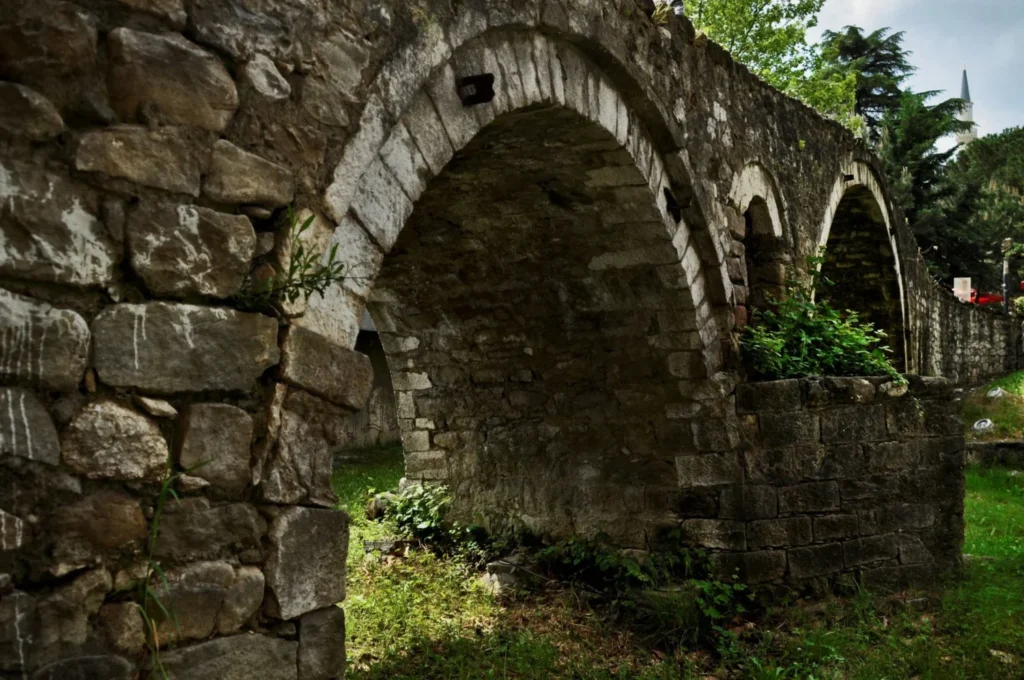
    The Tanners’ Bridge, built during the 18th century, connected the historic center with the Tanners’ Quarter and the eastern highlands surrounding Tirana.

    Constructed by the local guild of leather craftsmen, the elegant three-arched stone bridge remains one of the city’s best-preserved Ottoman civil engineering monuments.

    By 1881, Tirana had become one of Albania’s most important cities. Although administratively subordinate to Durrës, it had nearly three times its population, prompting Austrian diplomatic reports to recommend relocating the regional administrative center to Tirana because of its larger infrastructure, abundant water supply, and favorable climate.

    14:00 – 15:00

    Italian and Communist Architecture

    The final part of the tour explores the architectural transformation of Tirana during the twentieth century.
    Royal and Italian Tirana

    After Tirana became Albania’s capital in 1920, King Zog I commissioned Italian architects, particularly Gherardo Bosio, to design a new administrative center inspired by contemporary European capitals.

    Visitors will discover:
    • Mother Teresa Boulevard
    • Government Ministries
    • Prime Minister’s Office
    • Bank of Albania
    • University buildings
    • Monumental administrative architecture

    These buildings established the elegant urban identity that continues to characterize central Tirana today.
    Communist Tirana
    Following the Second World War, the communist government reshaped the city’s central square.

    Major landmarks include:
    • Skanderbeg Monument
    • Palace of Culture
    • National Historical Museum
    • Hotel Tirana
    • National Gallery of Arts

    The National Historical Museum is particularly notable for its monumental mosaic façade, illustrating Albania’s history from antiquity through the socialist period.

    15:00

    End of the Urban Historical Tour of Tirana

    The tour concludes in Skanderbeg Square, where visitors can appreciate how more than two thousand years of history—from Roman settlements and Byzantine fortifications to Ottoman monuments, Italian architecture, socialist urban planning, and contemporary development—combine to shape the identity of Albania’s capital.

    Multiple Days Tour

    Itinerary Map

    Photo Gallery

    Tour Details

    • Duration: Half Day (Approximately 5.5 hours)
    • Difficulty Level: Easy
    • Experience Type: History, archaeology, architecture, and urban heritage
    • Group Size: Suitable for individuals, small groups, and private tours
    • Languages: Albanian / English

    What's Included

    ✔ Professional licensed tourist guide
    ✔ Entrance to the Tirana Mosaic
    ✔ Guided visits to all monuments included in the itinerary
    ✔ Historical interpretation throughout the tour

    What's Not Included

    ✘ Meals and drinks
    ✘ Personal expenses
    ✘ Transportation (unless requested as part of the package)

    Suggested Price

    €…… / person
    The price includes:
    ✔ Professional tourist guide
    ✔ Entrance fees
    ✔ Guided historical tour

    Recap

    Discover the story of Tirana through more than two thousand years of history. Walk among Roman remains, Byzantine fortifications, Ottoman monuments, royal boulevards, and socialist landmarks, and experience how each era has contributed to the unique character of Albania’s vibrant capital.

    Subscribe to our Newsletter!