
Tirana Castle: A Fortress with Ancient Roots
In the heart of Tirana, on Toptani Street, stands Tirana Castle. It is traditionally said to have been built in the 18th century by Ahmet Pasha Bargjini, but archaeological evidence suggests that the origins of the fortress go much further back.
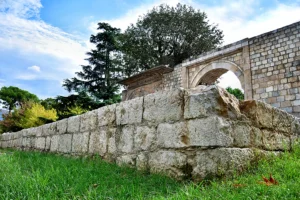
According to research conducted by archaeologist Sulejman Dashi in 2001, cited by Kristo Frashëri in The History of Tirana (p. 34), traces of an earlier structure were discovered beneath the present-day castle. On the northern side of the longitudinal wall along Abdi Toptani Street, archaeologists uncovered underground the remains of a square-plan tower, with walls approximately 2.90 metres thick. On the western wall, they also discovered the remains of an entrance, suggesting that both structures belonged to the same earlier construction phase.
The entire masonry structure of the tower had been buried beneath the cobblestone pavement during Bargjini’s construction of the later castle. The walls beneath the pavement extended more than two metres below the level of the cobblestones.
The masonry consists of roughly rectangular cut stones, arranged with a tendency toward horizontal courses on the inner faces, while irregularly shaped stones were embedded in a substantial amount of lime mortar. This construction technique appears to be characteristic of Late Antiquity.
Further excavations around the tower, which could potentially provide definitive evidence as to whether an ancient fortress once stood at the very heart of Tirana, were temporarily suspended by the Municipality of Tirana for urban-development reasons.
Nevertheless, the layout of Tirana Castle — approximately 160 × 200 metres, rectangular in shape and with its long side running parallel to the Lana River — suggests that it may have been one of the 4th–6th century AD lowland fortifications forming part of the defensive system constructed under the Byzantine Emperor Justinian I in the province of Epirus Nova (Epirus of the New).
These fortifications, however, did not withstand the barbarian invasions of Late Antiquity. The discovery of the defensive tower deep beneath the modern ground level may indicate that the settlement was eventually abandoned, perhaps toward the end of the 6th century.
There is also a fascinating historical possibility connected with the name Tyrkanos.
The Croatian medievalist Milan Šufflay, writing in 1924, suggested that one of the fortresses constructed in the 6th century and mentioned by Procopius of Caesarea in his account of Epirus Nova may have been located on the southern elevation of the broad plain in the middle of which modern Tirana stands.
If Šufflay’s interpretation is correct, Tyrkanos could potentially have been the fortress located at the site of today’s Tirana Castle.
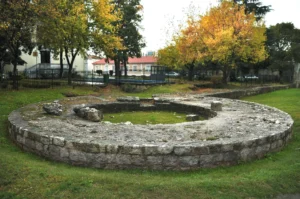
This remains an intriguing hypothesis rather than an established archaeological fact. Other scholars, including Kristo Frashëri, have argued that the Tyrkanos mentioned by Procopius may instead have been Tujan Castle, further east of Tirana.
The question therefore remains open: Could the fortress in the very heart of modern Tirana preserve the remains of the ancient Tyrkanos mentioned by Procopius? Further archaeological excavation would be needed to establish whether this connection can be confirmed.
Tags:

Other News to Read
Tirana Heritage Routes: 5+1 New Ways to Discover Tirana Beyond the City Centre
he Tirana Heritage Routes project presented five new thematic routes combining history, culture, heritage, nature, and local communities…
What to do in October 2026 in Tirana
Tirana, Hello Autumn! Welcome October! October in Tirana is a vibrant, colorful month — a lovely fusion of…
What to Do in Tirana in September 2026
What to do in September 2026 in Tirana . The month of Festivals and cultural activities
Tirana Castle: A Fortress with Ancient Roots
Tirana Castle: A Fortress with Ancient Roots. t is traditionally said to have been built in the 18th…