
Johann Georg von Hahn: Tyranna (Tirana) in 1854
1854/ Johann Georg von Hahn visited Tyranna (Tirana)
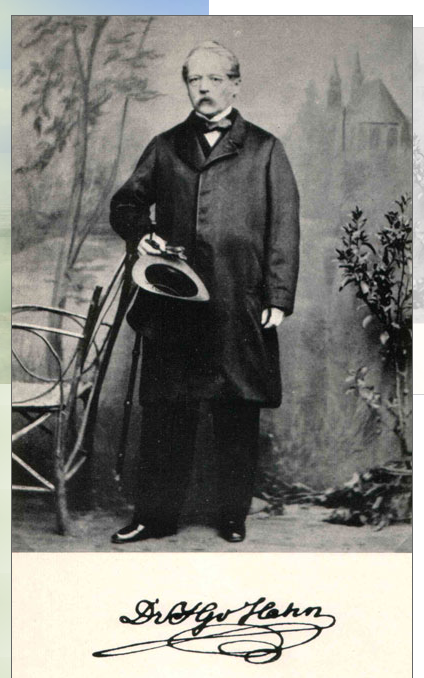
Tyranna [Tirana]. The town of Tirana and the valley made a very favourable impression on me. The people who live here are considered the most active and roguish of central Albania. The fields, gardens, and orchards are tended properly, and the latter two are well-fenced. The people are properly and cleanly dressed, the farm animals well cared for, and in most of the villages, there are two-storey, stone houses, which appear quite clean. Nowhere are there any traces of poverty or misery. I was particularly surprised by the town itself. I was expecting a sombre and dirty nest, but encountered a town extending over the watered plain with its gardens and trees. Closer inspection revealed, to my pleasure, that no one was starving or suffering.
Two little streams flow over the cobblestones of all the streets, taking all the refuse with them. The colourfully painted mosques, built in an attractive style and surrounded by poplars and cypresses, and the fine rococo tower with the town clock are surrounded by busy crowds of people swarming through the bazaar on official market days and making their way past the many buffalo carts. These are among the most picturesque views I saw anywhere in Albania. There was nothing unusual in the fact that the women from the surrounding countryside were at market, buying and selling their goods, since this is normal everywhere. But what I had not seen anywhere else were numerous women in Muslim urban dress, with many young faces among them, who were sitting on the steps of the mosque or on walls, selling undergarments and old clothes.
By the way, I noticed few people with blond hair and blue eyes here, whereas such individuals seemed very common in Labëria, Vlora, Tepelena and Gjirokastra. The farther north one travels, the rarer they become. I will refrain from commenting any further on Albanian racial characteristics because there is no country in Europe that offers more diversity of human forms than Albania, from individuals of great beauty to those of extreme ugliness […]
Sa e madhe është Tirana?
How large is Tirana? My notebook says: “The town has 2,000 houses, of which 100 are Orthodox (almost all Vlachs), six Catholic and the rest Muslim.” Boué, for his part, in Turquie d’Europe IV, p. 545, states: “Tirana, town with 300 houses, or 2,000-3,000 inhabitants, of whom a good portion are Muslim Ghegs.” Chose and pick. But where, on page 543, he claims there are 8,000 inhabitants in Durrës, with others giving 9,000 to 10,000, my notes give 1,000. I am quite sure that I am right because I spent more time in Durrës, was given the same reply by everyone I asked, and this figure seemed to correspond better to reality.
Old though the placename may be, Tirana is a young town, being according to legend, less than two hundred fifty years old. The following is told about the origins of the town:
Once there was a poor bey called Sulejman who had but one young lad as a servant. This lad dreamed one night that the moon fell from the heavens and landed on his right shoulder, radiating a strong light. When his master heard of the dream, he said to the boy, “You will one day be a great man. Go in God’s name and seek your destiny, because if you stay with me, nothing will become of you.” The lad set off and vanished, for he sent no word of his whereabouts. One day, a Tartar messenger arrived on horseback and summoned the bey to Constantinople to appear before the Grand Vizier., and the bey of course obeyed the order. When he was received by the Grand Vizier, it turned out that the latter was his former servant. The vizier entertained the bey lavishly and told him he could wish for whatever he wanted. The bey asked for command over the Sandjak of Ohrid. And so it was. Having taken up his new position, the bey went on a hunting expedition and found himself one day in Tirana, which at the time was a village of 15 houses and a couple of watermills. He was so taken by the location that he built the old mosque in the bazaar. When he set off to war against the Persians and feared he might perish, he gave orders that his body be embalmed and buried in the mosque. And so it happened. 240 years have passed since the death of Sulejman Pasha. The dynasty only died out recently and has been carried on through female lineage to the present Bey of Tirana.
The last descendant, Hadji Et’hem Bey suffered a curious fate. He was driven from Tirana by the Bey of Kroja [Kruja], his traditional foe, and wandered for years as a dervish in Asia. With the help of the last hereditary Pasha of Shkodra, Mustafa Pasha, he regained his inheritance, but after the fall of Mustafa Pasha, he was deposed by the Sadrazam, and Tirana was transferred to the rule of his traditional foes in Kruja, who still own it. Et’hem Bey fled to Elbasan, made peace with his foes and married the daughter of that family.
The following legend is recorded of the traditional enmity between Tirana and Kruja. Despite the hostile relations between the two towns, traders from Kruja managed to steal their way into Tirana market. To recognize them, guards were placed at the gates of the town who pointed to a wooden beam and asked those arriving what it was called. Those who called it trani were recognised as being from Kruja, and beaten up, because the people of Tirana pronounce the word trau.
Migrant workers are nothing unusual in the region of Tirana. The inhabitants of the mountain villages go to Constantinople to work as miners. And in the town, it is still custom for the men to go to Egypt as mercenaries. Most of the food reaches the town on beasts of burden. The horse-drivers of Tirana are famous in all of European Turkey.
Petrela [Petrela]
This is the Albanian name for the mountain fortress that is known in history as Scanderbeg’s Petrela. The traveller coming down from Krraba in the direction of Tirana will have it on his left for several hours. It is situated two full hours southwest of Tirana on an isolated peak in the mountain range stretching from Krraba to Cape Rodoni. This peak, probably over 1,000 feet in height, plunges almost vertically to the southwest and north, and therefore needs artificial fortification only to the east. The above-mentioned river Erzen interrupts the range on the northern side of the peak and flows in an east-west direction. The peak is thus the key to the upper valley that stretches towards it.
The peak is crowned with several tower-like constructions that are all in ruins. It conveys the overall impression of a dilapidated mediaeval fortress. The walls do not seem to contain any traces of antiquity and are all built with lime mortar. But the fact that the site was inhabited in ancient times can be seen in the fragments of cyclopean walls near the present settlement, about which we will come to speak. The settlement itself consists of several scattered groups, the individual houses of which are scattered among the olive trees. Despite its elevation, the settlement is rich in olive trees. The main part of the settlement is situated on a little plateau before you climb up to the top of the cliff. It has a little bazaar with a coffeehouse, and near it is the grave of Balambán [Balaban]. He was a courageous, miracle-working man who lost his head in an enemy attack when the Turks besieged Durrës. He, however, picked up his head, rode with it to Petrela, and deposited it at the site where his grave is currently situated. This is what they say in Petrela, at any rate. Barletius and Hammer, however, speak differently of Balaban. According to them, he was a local, Albanian-born warlord of the Turks who did battle with Scanderbeg and remained at the siege of Kruja. The reader would thus be forgiven if he were to suspect that the legend of the ride of St John Vladimir had crossed the mountains and been taken up by the Turks.
In the old order of battle of the province, the banners of the various towns were arranged as follows: First came Petrela and then Durrës, third was Derénje [Ndroq], of which we will come to speak, and then Kruja, Tirana, etc.
Tags:

Other News to Read
Johann Georg von Hahn: Tyranna (Tirana) in 1854
I was particularly surprised by the town itself. I was expecting a sombre and dirty nest, but encountered…
What to do in April 2026 in Tirana
April begins with numerous activities in Tirana. Some festivals feature music, art, and culture. April is also a…
Discover Dorëzi Castle- the oldest urban civilisation in Tirana
Discover Dorëzi Castle- the oldest urban civilisation in the Tirana Region
What to do in March 2026 in Tirana
Welcome Spring, the best season to Visit Tirana. March is the first month of spring, and the flowers…