
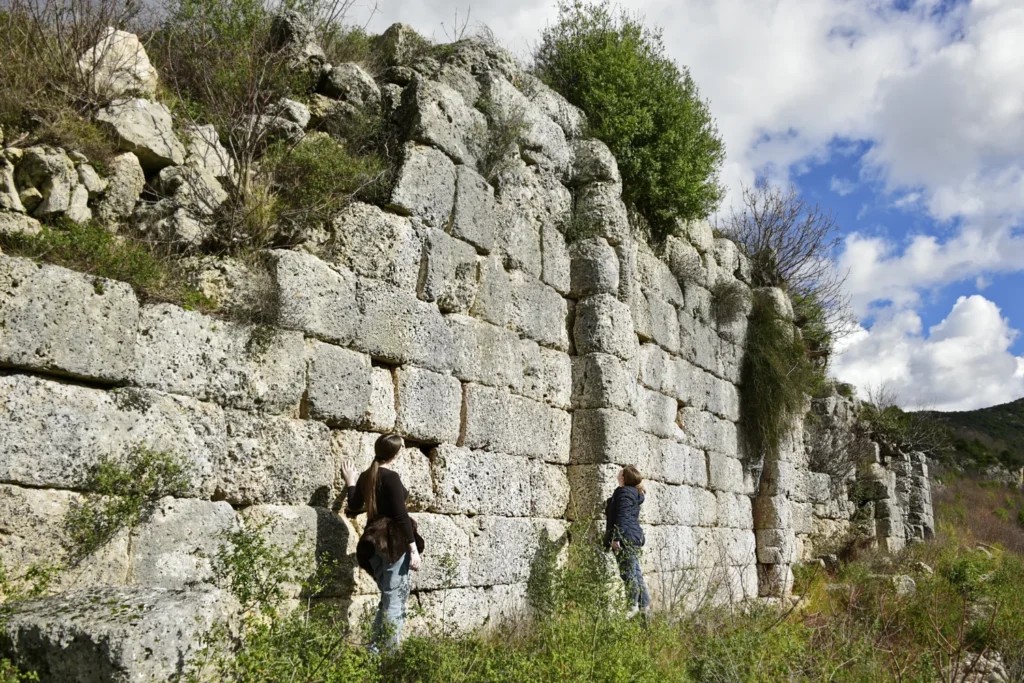

The Kings’ Tour traverses the territories of Petrela and Persqop, weaving together the history of these remarkable sites through historical accounts documented by both Albanian and international scholars. Why is it called the Kings’ Tour? The journey begins at the imposing walls of the ancient city of Persqop, also known as Brysaka. According to Albanian archaeologists, this site is believed to have been the capital of the Kingdom of the Taulantii, ruled by King Glaukias. Dating to the 4th–3rd centuries BC, the city was exceptionally advanced for its time. Today, its fortification walls—reaching heights of up to five metres—are the tallest surviving ancient walls in Albania. Historical sources describe them as so broad that two horsemen could ride side by side along their summit.
These same sources recount that King Glaukias provided refuge to the two-year-old Pyrrhus of Epirus until the time came for him to reclaim his royal position. Nearby, on Mount Vilë, stands a magnificent royal tomb, unquestionably belonging to a king, although its occupant has yet to be conclusively identified.
The narrative then continues to Petrela, whose fortress is believed to have been constructed using stone quarried from Persqop. A map produced in 1689 by Cantelli da Vignola (Cantelli de Rossi) identifies Petrela as the birthplace of Alexander the Great. Although this claim has never been historically verified, the map explicitly bears the inscription: “Petrela, tenuta patria di Alefs Magno” (“Petrela, reputed homeland of Alexander the Great”).
The tour of Petrela explores the fortress’s successive phases of fortification, including its development under the Toptani family, its role as the residence of Mamica Kastrioti, sister of Gjergj Kastrioti Skanderbeg, and the military engagements associated with the site. As Gjergj Kastrioti (Skanderbeg) has long been regarded by Albanians as their national king, the inclusion of both fortresses within this narrative gives rise to the name The Kings’ Tour.
In addition to its historical interpretation based on established sources, the tour includes carefully selected stops featuring authentic local restaurants, opportunities to experience the natural beauty of the region, and panoramic views of the Erzen Valley.